New: Foxtail Reporting App
There is a grass common in E20 that can burrow through your dog's body. Most dog owners have never heard of it.
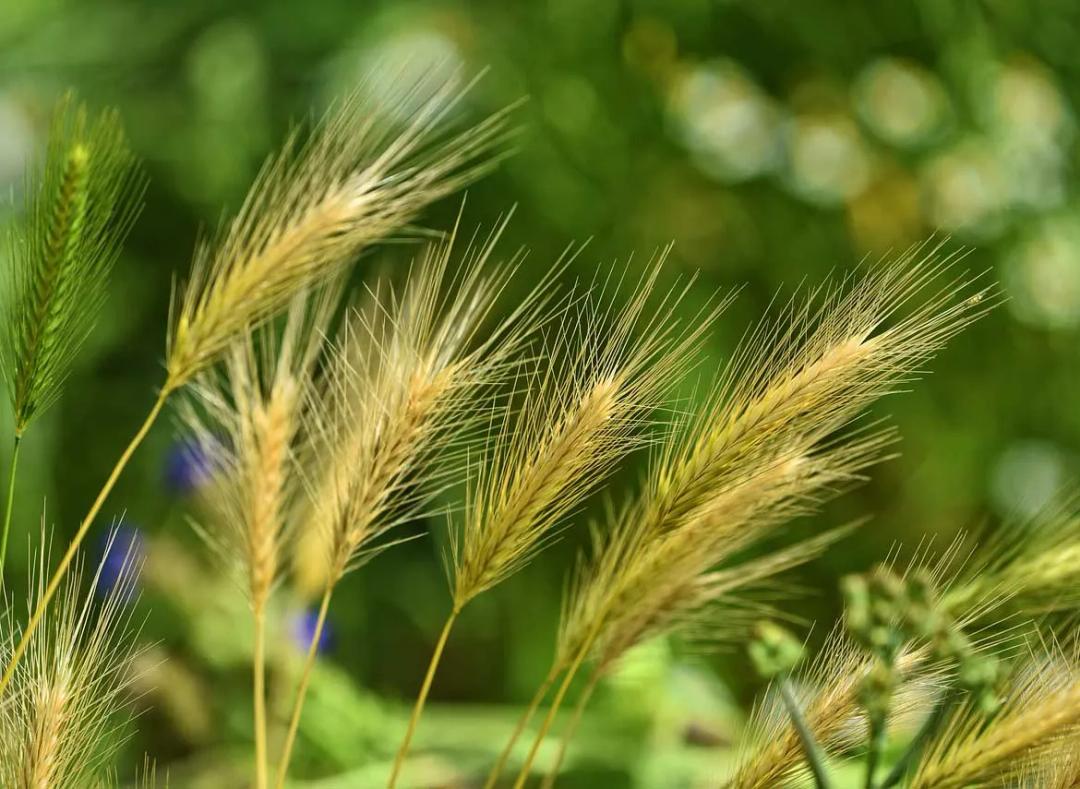
Foxtail grass - most commonly meadow foxtail (Alopecurus pratensis) and wall barley (Hordeum murinum) - produces seed heads covered in tiny barbed bristles called awns. The barbs face backwards, like a fish hook. Once they catch on fur or skin, they move in one direction: inward. They do not dissolve. They do not pass through. They migrate.
Most encounters are minor. You might notice your dog chewing at a paw, or shaking their head repeatedly after a walk. Often the awn is visible and can be removed with tweezers. But left unnoticed, the same seed can work its way into the ear canal, the tissues around an eye, the nasal passage, or deeper into the body. In serious cases, grass awns reach the lungs and cause a life-threatening infection called pyothorax.
The season runs roughly May to August in the UK - and that is right now.
Where it grows in E20
Foxtail grass is not a lawn grass. You will not find it on a freshly mowed pitch. But mowing schedules in E20 are inconsistent - grass that looks managed one week can be knee-high three weeks later, and that is exactly the window when seeds develop and become dangerous.
The risk is not just in obviously wild areas. It is in the gap between cuts.
The highest concentration we have recorded is around Victory Park and Portlands, where areas have been deliberately allowed to develop into meadow grassland. The intention is ecological - managed meadow is genuinely better for biodiversity than mowed grass. But meadow grassland in summer is foxtail habitat. These areas are not fenced off from dogs, and many residents walk through them daily without knowing what is growing there.
Beyond those hotspots, watch out anywhere the grass is tall and seeding: canal-side margins heading north toward Hackney Wick and south toward Three Mills, the scrubby strips between paths and fences around the estate, and any verge or rough edge that sits between maintenance visits.
What to check after every walk
Run your hands slowly through your dog's coat from nose to tail after any walk where they have been near long grass. Pay particular attention to:
- Between every toe, and underneath the paw pads
- Inside and around both ears
- Around the eyes and muzzle
- The armpits and groin
You are feeling for small, hard, elongated seed heads — roughly the size of a grain of rice, pale to golden brown when dry. They may already be partially embedded and harder to find.
Warning signs to act on immediately
If your dog shows any of the following after a walk in or near long grass, see a vet the same day:
- Persistent sneezing, or pawing at the nose
- Sudden, repeated head shaking or scratching at one ear
- Squinting, eye discharge, or visible irritation around an eye
- Excessive licking of one specific area, particularly a paw
- Swelling, a soft lump, or an area that has started to discharge
Do not wait to see if it resolves. The awn continues to move deeper over time. Early removal is straightforward. Late removal may require surgery.
If your dog is showing difficulty breathing, high temperature, lethargy, or unexplained fever after a period of other symptoms - go to an emergency vet without delay.
Why we built Foxtail Watch
After foxtail sightings became a recurring concern in the East Village community, we wanted to do more than publish a one-off warning. We built a live risk map for E20.
Foxtail Watch pulls real sighting data from iNaturalist - a global community science platform where verified naturalists log plant and animal observations with photos and GPS coordinates. We query it daily for the five awn-producing grass species most common to E20, and plot every confirmed sighting within 3km of the estate on a map.
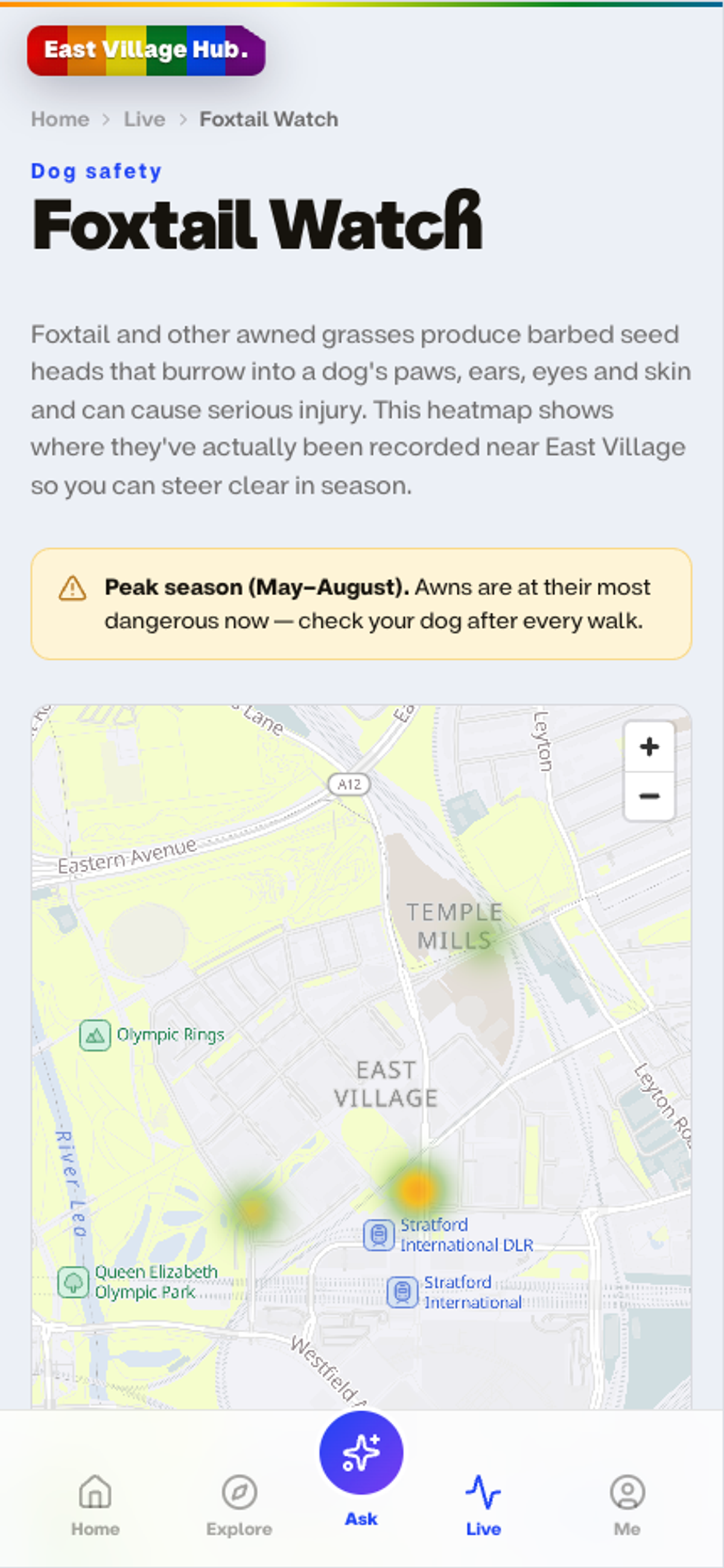
Alongside that, we have built a community reporting tool. If you spot foxtail grass on your walk - or if your dog has been affected - you can report the location directly on this page. Reports are reviewed by the EVH team and added to the map.
The map covers the main dog-walking areas of East Village, the canal corridor, the southern meadow edges of QEOP, and the surrounding streets. We will expand coverage as sighting data grows.
A note on the park planting
The naturalistic grass planting in QEOP was designed by landscape ecologists and is part of what makes the park a genuinely biodiverse space. This article is not a criticism of that approach. The goal of Foxtail Watch is awareness, not alarm. Dog owners who know where the risk is concentrated can make informed choices about where their dogs roam off-lead during the summer months.
If you believe a specific area needs more regular cutting or management, the right route is to contact the London Legacy Development Corporation (LLDC), which manages the Olympic Park, and EVML who manage the land around East Village.
Report a sighting
If you walk a dog in E20, you are part of what makes this useful. Every sighting you add improves the map for every other dog owner in the area. It takes less than two minutes.
EVH is a community platform for East Village, E20. Foxtail Watch is updated daily using data from iNaturalist and community reports.
Comments
Loading comments…
Your account has been blocked from commenting. Contact us via the contact form if you'd like to discuss.